Posted by
The Bear Safety Team
on
September 16, 2026
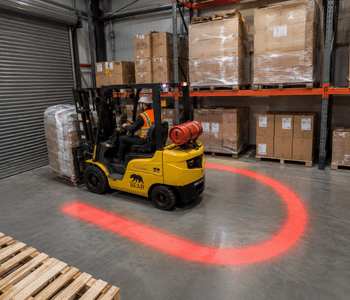
The highest-risk traffic points are often the places where people receive the least information. At a blind corner, doorway or busy crossing, an active warning can make an approaching vehicle more apparent before the two routes meet.
A painted line can define a route, but it cannot tell a pedestrian that a forklift is approaching. A wall sign can explain a rule, but it does not know whether a hazard is present. These static controls remain important, especially for route definition and instruction. At locations where visibility changes from moment to moment, an active vehicle warning can add timely information.
Active systems use detection or a control signal to trigger a light, sound, projected symbol or change in a crossing. Because the warning is linked to movement, it can focus attention on a specific event. The aim is not to replace safe layout or segregation. It is to strengthen awareness where a residual interaction remains.
Forklift and pedestrian conflicts are rarely distributed evenly across a site. They cluster around places where routes converge, sight lines are restricted or priorities are unclear. Stock and racking can hide movement. Noise can mask an engine or alarm. A door can allow a pedestrian to enter a vehicle route with almost no view of what is coming.
A useful risk review identifies these points individually. Instead of asking whether the whole warehouse needs more warnings, ask which movement gives users too little time to see, understand and respond.
High racking can prevent a forklift operator and pedestrian from seeing one another until both reach the end of the aisle. Convex mirrors may help when they are correctly positioned and users remember to check them, but visibility may still be limited by angles, stored goods or changing layouts.
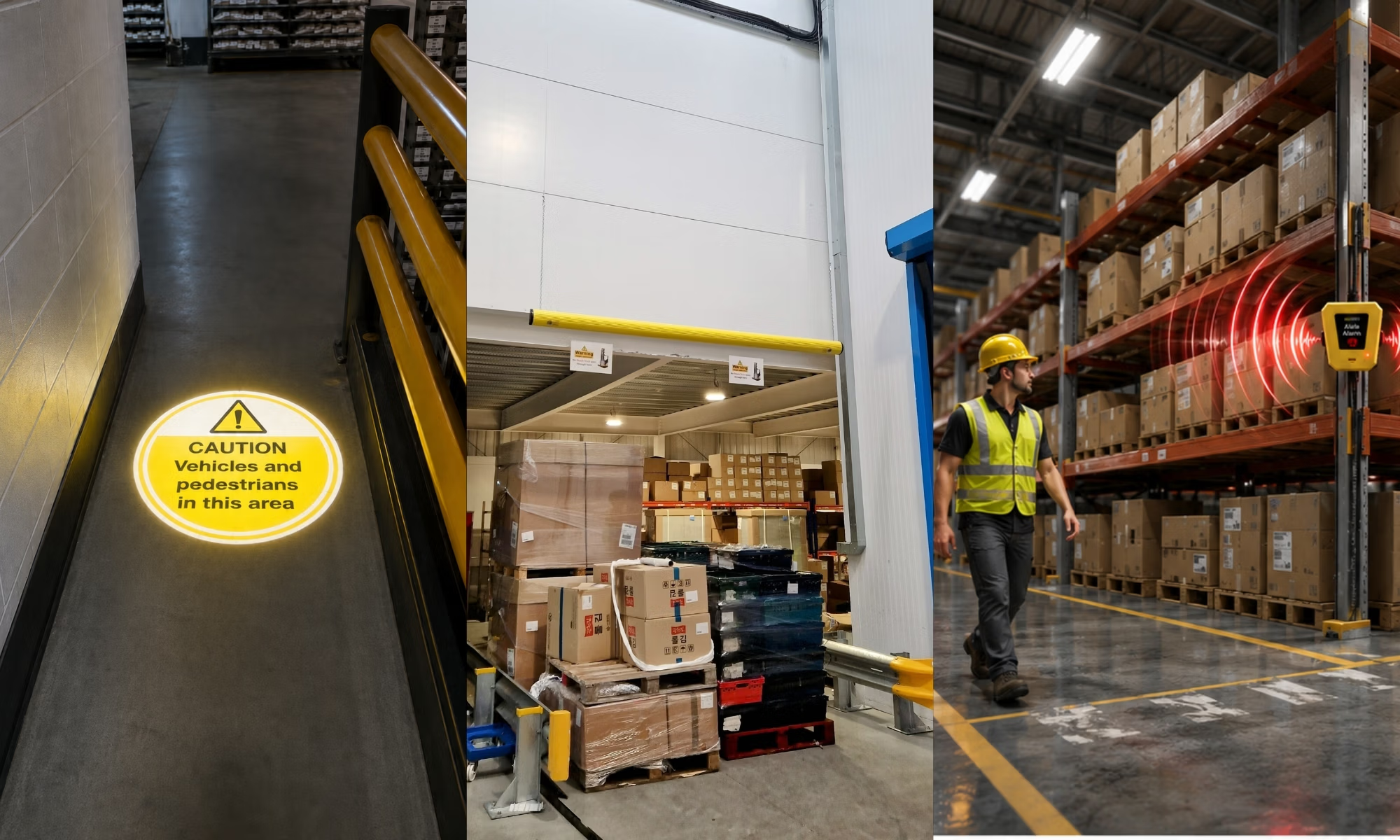
A dual-direction aisle alarm can detect movement on the approaches and activate a high-visibility LED, an audible alert or both. Another option is a projected warning placed in the user's forward view. The alert should activate early enough to support a controlled approach, while the detection zone should avoid responding to unrelated activity in neighbouring aisles.
Personnel doors, rapid doors, strip curtains and freezer entrances can create abrupt transitions. A pedestrian may step from a quiet internal area into an active forklift route. Equally, a driver approaching the doorway may have no way to know that someone is about to emerge.
Where possible, redesign the exit with a barrier, protected waiting area or offset route so users cannot step directly into traffic. An active doorway alert can then add another layer. A sensor may detect an approaching vehicle and trigger a message such as STOP, FORKLIFT APPROACHING or DO NOT ENTER in the relevant decision area.
Crossings should be located where visibility is good and vehicle speeds are controlled. In practice, space constraints may place them near production lines, racking or busy junctions. A permanently marked crossing can also create uncertainty if users assume it always gives the same priority.
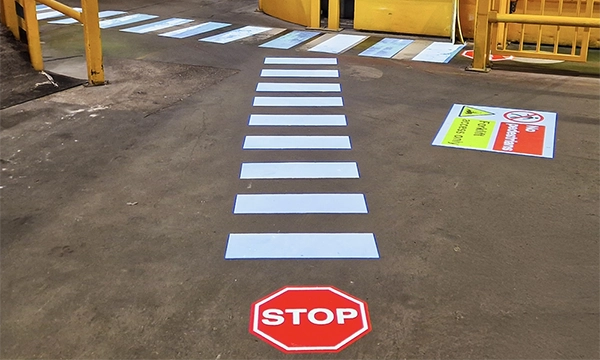
An automated crossing can change its visual state when a forklift is detected. For example, a projected pedestrian crossing may be visible during normal conditions and disappear when a vehicle approaches, while warning symbols activate for pedestrians. The exact logic must be designed around the site's agreed priority and safe system of work. Every user should understand what each state means.
Loading areas are difficult because pedestrian work and vehicle movement may occur at the same time. Drivers can have restricted rearward vision, while employees may focus on loads, paperwork or equipment. HSE guidance recommends avoiding or reducing reversing where possible, then using suitable controls for manoeuvres that remain.
Active warnings may include reversing alarms, warning lights, detection systems or projected danger zones. Their role should be specific. One device may warn the driver of an obstruction, while another warns pedestrians not to enter a defined area. Marked exclusion zones, controlled access and clear responsibility for the operation remain essential.
Very narrow aisle operations often leave little room for pedestrians and vehicles to coexist. The primary rule may be to prevent pedestrian access while a truck is operating. Static signs communicate the rule, but they can be overlooked when seen every day or may not reflect whether the aisle is currently active.
A sensor- or control-activated NO PEDESTRIANS warning can make the restriction relevant to the actual operating state. Manual controls may also be appropriate for temporary maintenance or access conditions. The system should fail safely, make its status clear and fit the site's access procedure.
Most location-based systems follow three simple stages:
The quality of the outcome depends on all three stages. A bright warning will not help if the detection zone activates too late. Accurate detection will not help if the message is ambiguous. Commissioning should therefore test the complete sequence under realistic traffic conditions.
It is also worth asking whether the warning remains necessary after a layout change. In some cases, moving a doorway, adding a barrier or changing the route provides a stronger control. Technology should support good traffic design, not freeze a poor arrangement in place.
Active warnings are most useful when people can understand them quickly. Use familiar symbols, short wording and consistent colours. Avoid asking users to interpret several states unless the distinction is essential. If an automated crossing changes priority, the induction and site rules must explain the sequence clearly.
After installation, observe behaviour rather than checking only whether the hardware activates. Do pedestrians pause at the intended point? Do forklift operators approach differently? Are false activations encouraging people to ignore the signal? Use this evidence to adjust detection, positioning and procedures.
A site does not become safer simply because it contains more alarms or lights. Active vehicle warnings add the most value at well-defined conflict points where users cannot reliably see the hazard early enough. When combined with segregation, route control, training and maintenance, they can provide a clearer and more responsive workplace traffic environment.
Bear Safety designs site-specific active warnings for blind corners, doorways, crossings and restricted areas. Book a site survey to review the movement, visibility and warning requirements at your priority locations.
Proactive Safety Solutions for reducing risk in industrial environments.

Proactive Safety Solutions for reducing risk in industrial environments